
Acoustic certificate
Measured in the room, not in a catalogue
Sound tests are run with acoustic engineers, in the real room and with the project installed. This is what is measured. And also what we cannot publish yet.
Who measures
Sound tests are carried out with acoustic engineers. Each system is verified in the space where it is going to work, which is where it is decided whether the room responds or not. An empty room in a laboratory does not tell you what will happen in yours.
Why the open pore
We choose natural fabrics that keep the pore open: it is what lets sound through to the absorbent material behind. Primed fabrics tend to seal the pore.
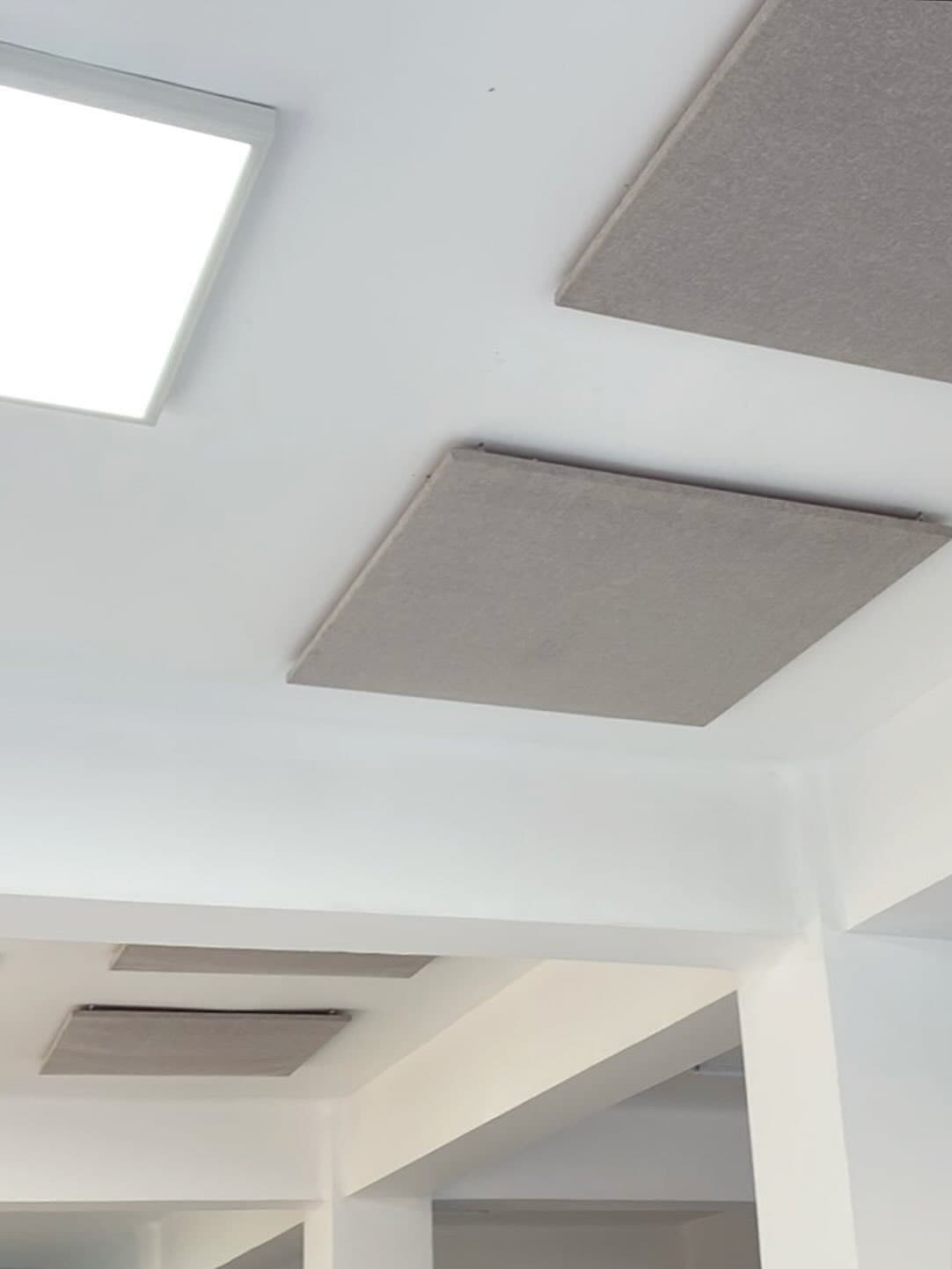
A measured case
A 170 m² floor 3.2 metres high: 544 m³ of air, hard floor and bare walls. 32 panels were installed, 17.96 m² of absorbent surface, 10.6% of the floor area.
Reverberation fell from 2.04 to 1.2 seconds in the 100 Hz band.
- Floor area
- 170 m²
- Volume
- 544 m³
- Panels
- 32
- Absorbent surface
- 17.96 m² · 10.6%
- Mean reverberation before
- 1.51 s
- Mean reverberation after
- 0.97 s
- Mean improvement
- 0.54 s
- Measured bands
- 18
What we do not publish yet
A certificate is quoted with its number or it is not quoted at all. Today the report number and the laboratory, the test standard, the per-band absorption coefficient and the fire classification are not published, so we do not give them.
When the report is ready, it will be published here in full. Until then, what we have are measurements from real rooms, before and after, with the date and the space.
A second room
There is a second measurement, in an 11.6 m² room, with and without panels. We do not publish it as data: the only chart that exists of it has its frequency axis out of order and carries no readable values, and in the two lowest bands the treated curve does not sit below the other. It goes up when the measurement sheet does, like the one above.
Want to know how your space sounds before deciding anything?