
Acoustic option
Why a room sounds bad
It is not the noise outside. It is the sound inside, taking too long to die away. All the technical story is here: what a panel does, what we measure and how it sounds.
Reverberation, in one sentence
When someone speaks, the sound bounces off floor, walls and ceiling before fading. The time it takes to fall 60 decibels is the reverberation time. When it is long, each word is still ringing when the next one starts: conversations overlap, voices rise, and a full day in that room is tiring without anyone knowing why.
What a fabric panel does
A hard surface returns sound. A KalmArt panel lets it in: the open-pore fabric does not stop it, and behind the cloth sits acoustic material, which is what absorbs. That is why the fabric and the build matter, not the picture. A conventional painting hung flat absorbs almost nothing.
- 1Open-pore fabric
- 2Acoustic material
- 3Wooden stretcher
- 4Wall
- Sound enters and stays inside
Section detail through the edge of a panel. The drawing states the order of the materials, not their dimensions: no measurement is published here that has not been measured.
The measured case
A 170 m² room, measured before and after
18 third-octave bands, taken in the same space with the room bare and with the 32 panels in place. The mean went from 1.51 to 0.97 seconds. This is not a catalogue value: it is that room.
| Band | Before | After |
|---|---|---|
| 100 Hz | 2.04 | 1.2 |
| 125 Hz | 1.84 | 1.26 |
| 160 Hz | 1.64 | 1.41 |
| 200 Hz | 1.55 | 1.31 |
| 250 Hz | 1.4 | 1.16 |
| 315 Hz | 1.48 | 1.13 |
| 400 Hz | 1.48 | 1.05 |
| 500 Hz | 1.42 | 0.96 |
| 630 Hz | 1.49 | 0.88 |
| 800 Hz | 1.48 | 0.81 |
| 1000 Hz | 1.5 | 0.81 |
| 1250 Hz | 1.48 | 0.78 |
| 1600 Hz | 1.49 | 0.76 |
| 2000 Hz | 1.48 | 0.78 |
| 2500 Hz | 1.43 | 0.79 |
| 3150 Hz | 1.4 | 0.79 |
| 4000 Hz | 1.33 | 0.78 |
| 5000 Hz | 1.25 | 0.76 |
THE MEASUREMENT, HEARD
The same room, twice
The curve above says how long sound lasted in each band. Below is that same measurement read in time: how long the tail takes to die away with the room bare and with the 32 panels installed.
Both curves start from the same point: at the instant of the clap the room is just as loud either way. What changes is how long it takes to go. Across the 18 measured bands the mean falls from 1.51 s to 0.97 s. The dotted lines mark where the next clap lands: in the untreated room the previous one is still sounding there.
The measurement, read in time.
The curve above is the data; the audio is a reading of that same curve.
This page takes as long to fade as that room did: 1.51 s at the top, 0.97 s further down. Measured, not chosen.
How much surface it takes
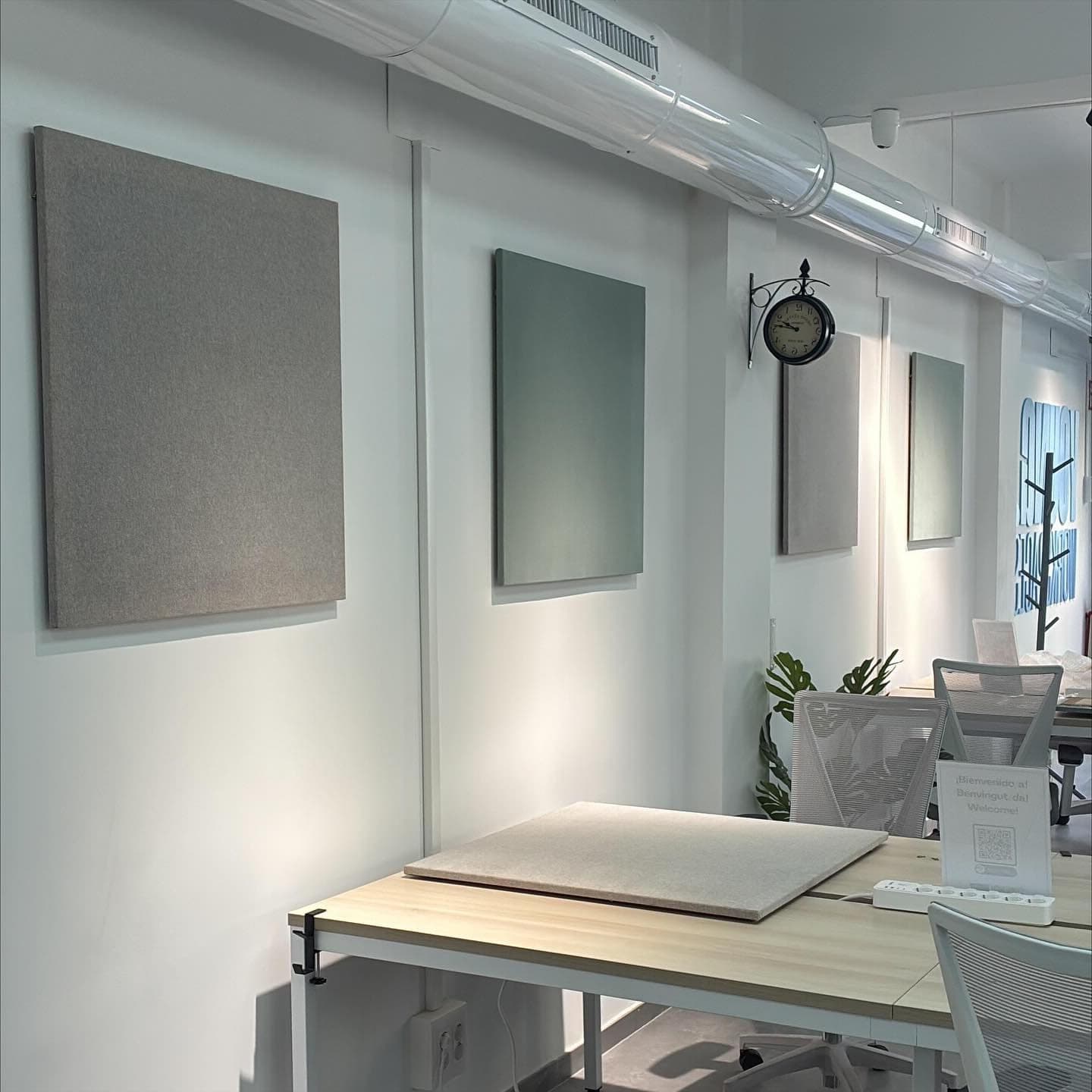
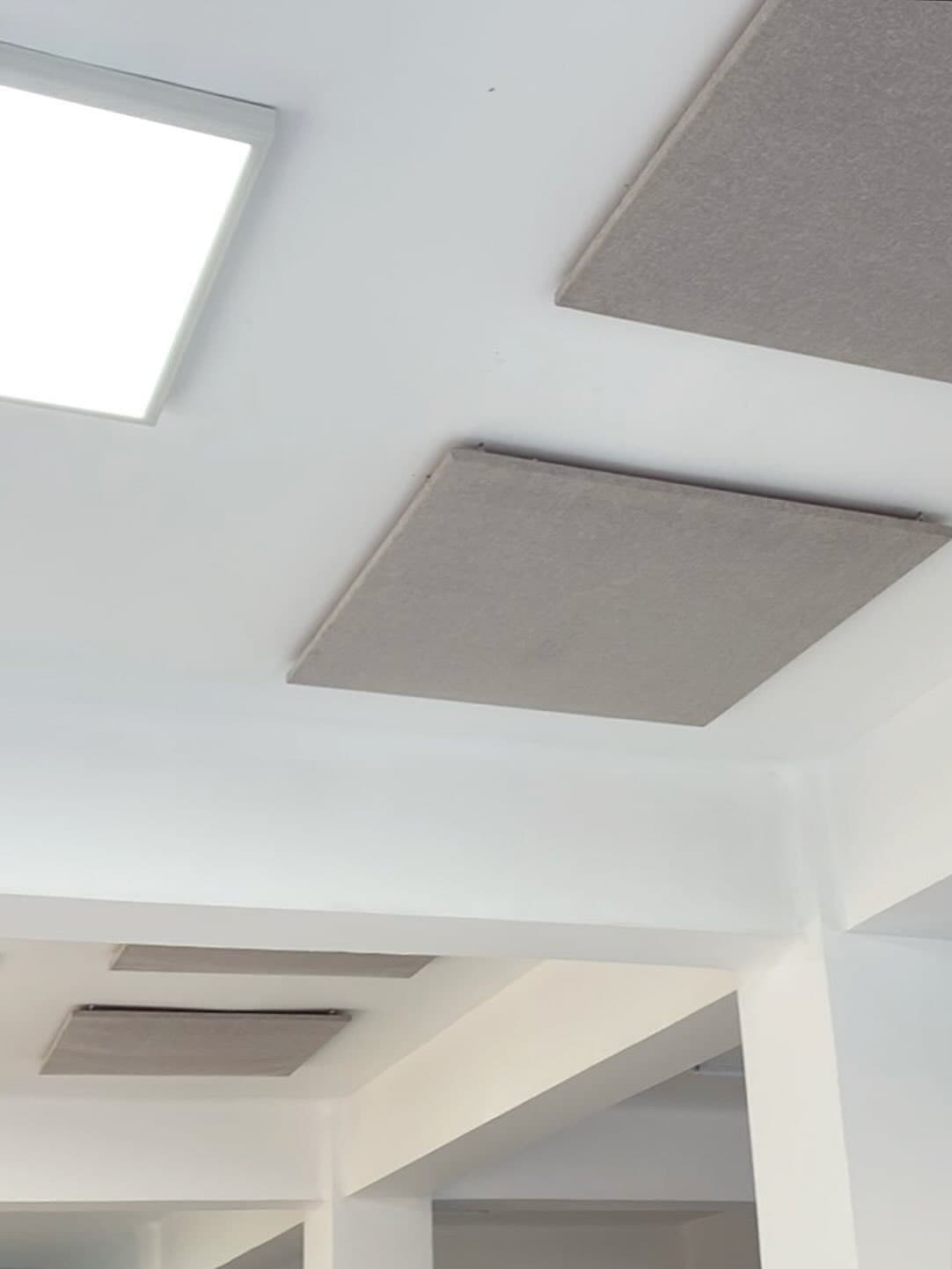
It depends on the volume of the room and how hard it is. In the room above it took covering 10.6% of the floor area, 17.96 m² of absorbent surface, to bring reverberation down by 0.54 seconds on average. You do not need to line a wall: you need to distribute well.
Where they go
What we do not publish yet
Per-band absorption coefficients and fire classification: under test. When they are ready they will be published here with the report number and the laboratory that signs it. Until then what we have are measurements of real rooms, which is more than most.
With or without acoustics
Any panel can be made with acoustic treatment or purely decorative. Tell us about the space and we reply with a concrete proposal.